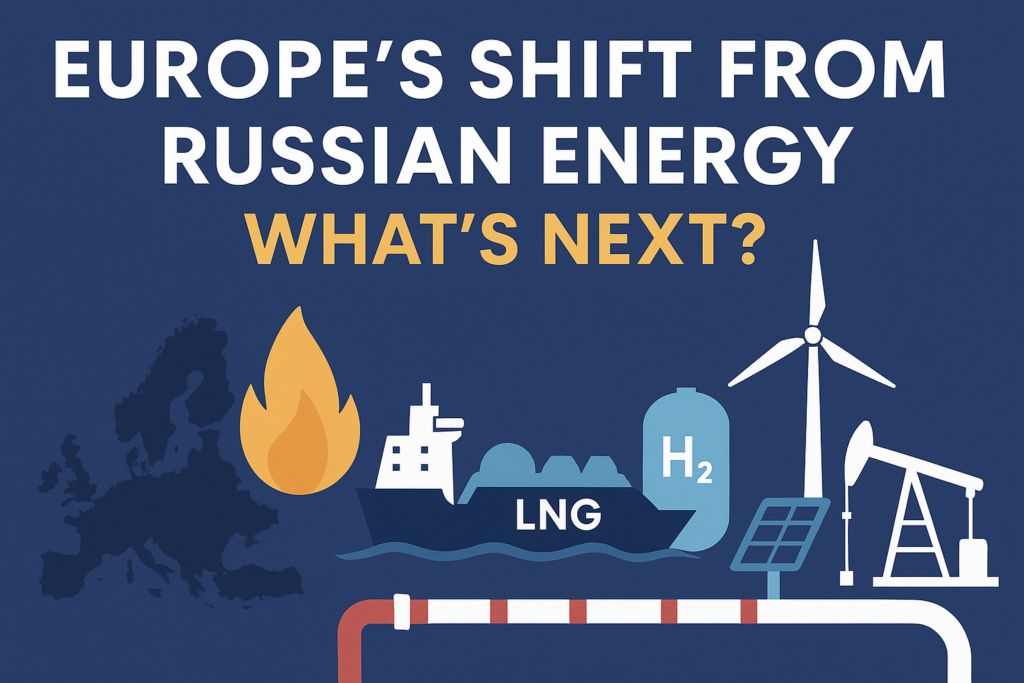
Introduction: A Historic Shift in Global Energy
For more than two decades, Europe relied heavily on Russia for its energy needs. Russian oil, natural gas, and coal powered European factories, heated homes, and kept electricity prices low. But after the Russia–Ukraine conflict in 2022, everything changed. Suddenly, Europe had to find new energy suppliers, control the price rise, and protect its economy from a major energy shock.
This shift is not only important for Europe—it has changed the global energy market. Countries like the United States, Qatar, India, and China are all impacted by Europe’s decisions. The world is entering a new era where energy security, clean power, and global alliances matter more than cheap pipelines.
This article explains Europe’s full journey, the crisis it faced, the solutions it adopted, and what the future looks like.
1. Why Europe Was Dependent on Russian Energy
Before 2022, Europe imported a huge portion of its energy from Russia. The numbers were massive:
- 40% of Europe’s natural gas
- 27% of crude oil
- 46% of coal
Why so much dependence?
A. Cheap and stable supply
Russia offered affordable long-term contracts and consistent delivery.
B. Easy transportation
Pipelines like Nord Stream 1 made gas transportation efficient and low-cost.
C. Political cooperation
For years, Europe and Russia had stable economic relations, especially Germany and Italy.
D. Industrial needs
European industries—chemicals, steel, fertilizers, and manufacturing—needed cheap energy to stay competitive. Russian gas provided that advantage.
This created a deep connection, but also a dangerous dependency. When the Ukraine war began, that risk became reality.
2. How the Russia–Ukraine War Changed Everything
The conflict led to immediate tensions. Europe imposed sanctions on Russia, and Russia responded by cutting or reducing gas supply.
The consequences were severe:
- Gas prices increased more than 10 times.
- Electricity bills doubled or tripled for many households.
- Industries in Germany and Italy faced shutdowns.
- Inflation touched 40-year highs in several countries.
- Governments struggled to protect consumers.
This was Europe’s biggest energy crisis since World War II.
3. Europe’s Emergency Response (2022–2023)
To avoid blackouts and economic collapse, Europe acted faster than ever before.
A. Forced Reduction of Gas Consumption
Europe cut gas use by around 15–20% through:
- Lower industrial demand
- Energy-saving rules
- Reduced heating in buildings
B. Filling Gas Storage to 90–95%
Europe rapidly filled underground gas storage before winter. This acted like a “backup battery” and avoided shortages.
C. Building New LNG Terminals
Countries constructed new LNG (liquefied natural gas) ports in less than a year, a process that normally takes 5–7 years.
Germany built its first LNG terminal in just 194 days.
D. Switching to Alternative Suppliers
Europe started importing from:
- USA
- Qatar
- Algeria
- Norway
- Nigeria
This reduced dependency on Russian pipelines.
E. Financial Support for Citizens
Governments spent over €600 billion to subsidize electricity, control fuel prices, and support industries.
Europe survived—but at a very high financial cost.
4. The Rise of LNG: Europe’s New Energy Lifeline
With pipeline gas from Russia reduced, Europe turned to LNG as its main replacement.
What is LNG?
LNG is natural gas cooled to a liquid state and transported in ships.
Which countries benefited most?
- United States: Became Europe’s No.1 LNG supplier
- Qatar: Increased LNG contracts
- Norway: Became the largest pipeline gas supplier
LNG’s advantages:
- Flexible supply
- Available from many countries
- Risk-free compared to pipelines
But LNG has challenges:
- More expensive than pipeline gas
- Requires terminals and storage
- Dependent on global demand
- Price fluctuations
Still, LNG helped Europe stabilize energy markets quickly.
5. Europe’s Renewable Energy Boost
To avoid future dependency, Europe increased investment in clean energy.
Key targets:
- 45% renewable energy share by 2030
- Net-zero emissions by 2050
Major renewable projects:
A. Solar Energy
- Spain, Greece, Italy seeing record installations
- Rooftop solar growing in Germany and Netherlands
B. Wind Energy
- Large offshore wind farms in the North Sea
- UK, Netherlands, Denmark leading the sector
C. Hydropower
- France, Norway, Switzerland expanding capacity
D. Green Hydrogen
Germany, Spain, and Portugal planning major hydrogen corridors.
Result:
Renewables are becoming cheaper than fossil fuels, reducing Europe’s long-term reliance on imported energy.
6. The Nuclear Power Debate
Several European countries are reconsidering nuclear power as a stable, low-carbon energy source.
Countries expanding nuclear:
- France (largest nuclear user)
- Finland
- Czech Republic
- Poland
Countries opposing nuclear:
- Germany (shut down last plants in 2023)
- Austria
- Belgium
Nuclear remains controversial, but it may grow as Europe seeks energy security.
7. Impact on Russia: Where Did the Oil & Gas Go?
Europe’s exit forced Russia to redirect exports to Asia.
Main buyers now:
- India
- China
- Turkey
India became one of the biggest buyers of discounted Russian oil.
Result for mascow :
- Export revenue fell
- Logistics costs increased
- Loss of western market (high-value, long-term contracts)
8. Impact on Global Energy Markets
Europe’s decisions changed the whole world:
A. LNG prices increased globally
Asian and African nations paid more.
B. Shipping routes changed
More tankers traveled to Europe instead of Asia.
C. Renewable investment increased
Worldwide clean energy investment crossed $1 trillion.
D. Oil trade patterns shifted
India and China became the new buyers of Russian crude.
E. Industry relocation
Some European industries shifted production overseas due to high energy prices.
9. Europe’s Long-Term Strategy (2024–2030)
The energy shift is permanent. Europe is not going back to Russian dependency.
1. Diversified Energy Sources
Europe wants multiple suppliers:
- USA
- Qatar
- Azerbaijan
- Norway
- North Africa
No single-country dependence anymore.
2. More LNG Terminals
Europe plans more terminals in:
- Germany
- Italy
- Greece
- Poland
- Netherlands
3. Massive Renewable Investments
Solar, wind, hydrogen to dominate future expansion.
4. Strengthening the Energy Grid
A super-grid connecting European countries is being developed.
5. Electric Vehicles & Batteries
EU mandates all new cars to be electric by 2035.
10. Who Gains the Most? — Global Winners
A. United States
Became Europe’s top LNG supplier.
American energy companies made record profits.
B. Norway
Replaced Russia as the No.1 gas supplier to Europe.
C. Renewable Companies
Wind, solar, and hydrogen companies saw massive growth.
D. Asian Buyers (India & China)
Buying discounted Russian oil boosted their refining margins.
11. Challenges for Europe Ahead
Despite progress, Europe still faces risks:
A. High energy prices
LNG is expensive, affecting industries and households.
B. Competition from Asia
If Asia pays higher prices, Europe may face shortages.
C. Renewable dependency on weather
More wind and solar means Europe must improve storage systems.
D. Slow infrastructure development
Some countries still lack enough terminals and pipelines.
12. What’s Next? — The Future of Europe’s Energy
The next decade will shape Europe’s economic stability and global influence.
A. Cleaner, safer, diversified energy mix
More renewables + LNG + nuclear = balanced strategy.
B. Full exit from Russian gas
Europe aims to reduce Russian energy dependence to near zero.
C. Digital & smart grids
Better monitoring and energy efficiency.
D. Massive rise in hydrogen
Hydrogen may replace natural gas in many sectors.
E. Green industrial revolution
New factories, battery plants, and clean technologies.
Conclusion: A New Energy Era Begins
Europe’s move away from Russian energy is more than a political shift—it is a global turning point. The crisis forced Europe to rebuild its entire energy model in just a few years. While the transition was expensive and challenging, it opened the path for a cleaner, safer, and more resilient future.
The world is watching Europe closely, because its choices today will influence global energy markets, climate goals, and economic power for decades ahead.