Introduction
The world is undergoing a massive shift towards sustainable mobility, and at the forefront of this revolution in India stands Ola Electric. A subsidiary of ANI Technologies (the parent of Ola Cabs), Ola Electric has quickly grown from a bold idea into a formidable force in the electric vehicle (EV) market. With its vision of transitioning India to electric mobility, the company has disrupted the traditional two-wheeler segment and sparked serious interest among investors, consumers, and policymakers alike.
In this blog, we will explore Ola Electric’s journey, its innovative business model, products, financial fundamentals, shareholding pattern, and its future in India’s evolving EV ecosystem.
🚀 The Genesis of Ola Electric
Founded in 2017 by Bhavish Aggarwal, Ola Electric was initially established as an internal project within Ola Cabs to focus on electric mobility. It later evolved into a standalone company with a specific goal: to accelerate the adoption of electric vehicles in India.
The Indian EV market was relatively nascent when Ola Electric started out. But Bhavish saw the opportunity to create a brand that would cater to India’s growing urban population, fuel price volatility, and increasing environmental concerns. He envisioned an all-electric two-wheeler that could rival the traditional petrol scooter—both in price and performance.
🏍️ Flagship Products: Ola S1 Series
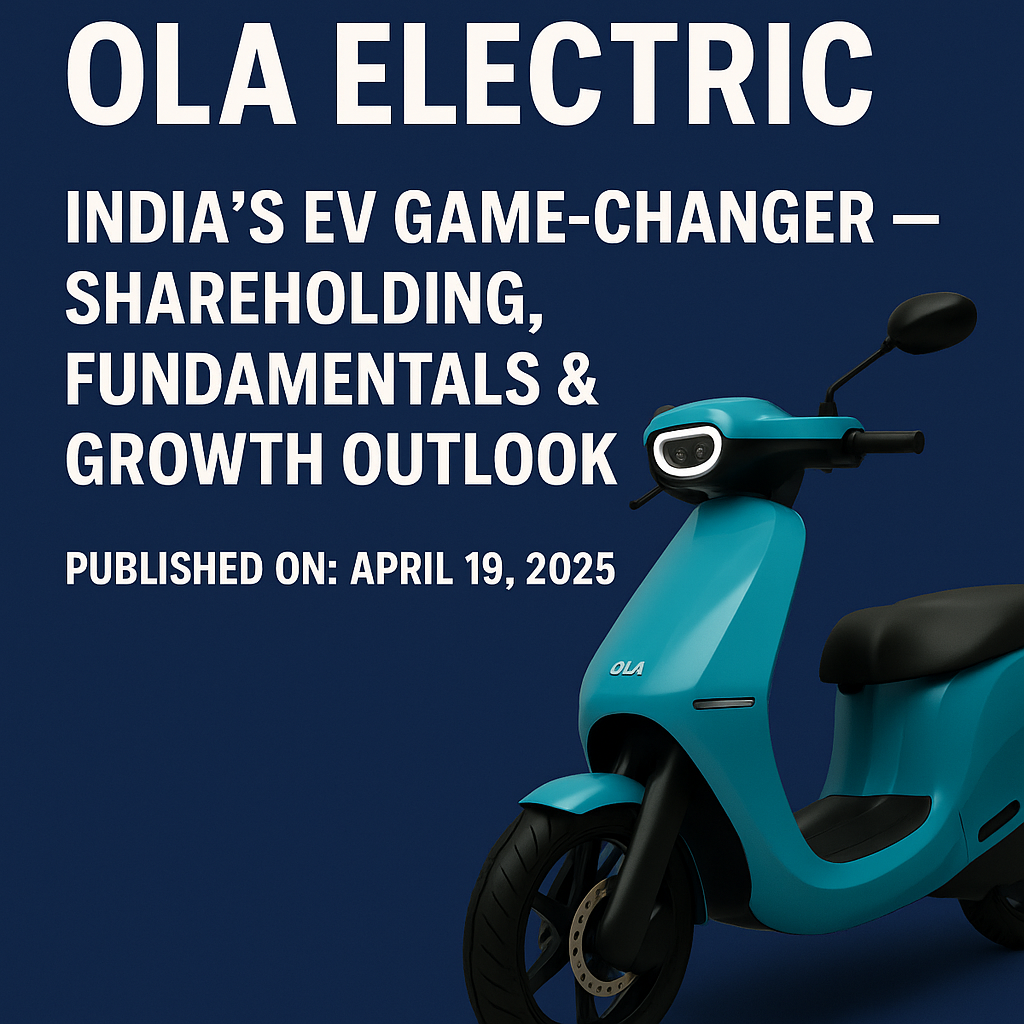
The company officially entered the EV market with the launch of its Ola S1 electric scooters in August 2021. These models were a blend of cutting-edge design, high performance, and affordability—key elements to attract the price-sensitive Indian buyer.
Key specifications of the Ola S1 series:
- Top speed of 90–115 km/h depending on variant
- Range of 121–181 km on a single charge
- 0–40 km/h acceleration in just 3 seconds (for S1 Pro)
- Smart features like app-based unlock, GPS, voice control, and digital dashboard
- Available in multiple colors and variants (S1, S1 Air, S1 Pro)
The launch received overwhelming response with lakhs of pre-orders, underscoring strong market demand for electric mobility alternatives.
🏭 Futurefactory: World’s Largest 2W EV Facility
To support its ambitious vision, Ola Electric built its Futurefactory in Tamil Nadu—an all-women-run, highly automated production plant capable of producing over 10 million two-wheelers annually.
- 500-acre facility
- Claimed to be the world’s largest 2-wheeler EV factory
- Highly automated with over 3,000 robots
- Zero emissions with sustainable energy use
The factory is part of Ola’s larger strategy to build a vertically integrated supply chain—from battery cells to final assembly—enabling cost efficiency and quality control.
📈 Financial Performance & Fundamentals
FY 2023–24 (as per TheKredible and company disclosures):
- Revenue: ₹5,243.27 crore
- Expenses: ₹6,821.62 crore
- Net Loss: ₹1,584.4 crore
- EBITDA: -₹1,040.1 crore
While these numbers might seem concerning at first glance, they’re typical for a growth-stage startup that is heavily investing in R&D, manufacturing capacity, and market acquisition.
Cost-Cutting Efforts
In early 2025, the company began taking major steps to improve its financial health, including cost-cutting measures that are expected to save over ₹900 crore annually. Operational efficiency and restructuring are being implemented to guide the company toward profitability.
📊 Shareholding Pattern (As of March 2025)
Ola Electric remains a closely watched stock in the Indian markets, especially post its IPO in August 2024.
- Promoters (Bhavish Aggarwal & Founders): 36.78%
- Retail Investors & Others: 56.57%
- Foreign Institutional Investors (FII): 2.10%
- Mutual Funds: 4.09%
- Domestic Institutional Investors (DII): 0.46%
The strong promoter holding indicates long-term belief and commitment to the company’s future, which often bodes well for investors.
📉 IPO & Share Performance
Ola Electric went public in August 2024 with a much-anticipated IPO. It was priced at ₹76 per share. Initially, investor enthusiasm drove the stock up, hitting a 52-week high of ₹157.40.
However, volatility soon followed due to:
- Heavy competition in the EV space
- Rising input costs
- Negative news around insolvency petitions by a creditor (which the company has denied)
- Market skepticism about achieving profitability
As of March 2025, the stock trades at ₹47.4, well below its IPO price.
⚠️ Challenges Ahead
Like any disruptive startup, Ola Electric has its fair share of hurdles to overcome:
1. Financial Sustainability
Though revenue has grown, consistent losses and high capital expenditure could put strain on the company if profitability remains elusive.
2. Quality & Customer Service
Ola has received mixed feedback from early adopters on scooter build quality and after-sales service. Scaling customer service for millions of users is essential.
3. Regulatory Environment
EV policies are still evolving. Subsidy reductions, import duties on battery cells, or compliance hurdles can impact cost and operations.
4. Market Competition
Competitors like Ather Energy, TVS, Bajaj, and Hero Electric are rapidly growing. International players like Honda are also eyeing the Indian EV two-wheeler market.
5. Insolvency Petition
In March 2025, a creditor filed a petition against one of Ola’s subsidiaries. Though Ola denied any wrongdoing, such legal disputes can tarnish reputation and stock performance.
🔋 Ola’s Broader Vision
Ola Electric isn’t just a two-wheeler brand—it’s building an EV ecosystem. This includes:
🔋 Battery Innovation
The company plans to manufacture lithium-ion battery cells in India. It’s already conducting R&D in-house and plans to establish a battery gigafactory.
🔌 Charging Infrastructure
Ola aims to create a pan-India Hypercharger Network, enabling fast charging in cities and on highways.
🌱 Electric Cars
In 2022, Ola teased its plans for a Made-in-India electric car with a futuristic design and advanced features, potentially launching in 2025 or 2026.
🌏 Global Expansion
With rising interest in affordable EVs globally, Ola may eventually expand into Southeast Asia, Latin America, and parts of Europe.
🧠 Investor Takeaway: Should You Invest?
Whether you’re a retail investor or an institutional one, Ola Electric presents a high-risk, high-reward opportunity.
✅ Reasons to Consider Ola Electric:
- Strong brand recognition
- High market potential in India (EV penetration still <10%)
- Vertical integration gives long-term cost advantages
- Ambitious founder with a clear long-term vision
- Government support for EV industry
❌ Risk Factors:
- Negative cash flows and consistent losses
- Quality and service issues could hurt brand loyalty
- Legal and regulatory hurdles
- High competition from deep-pocketed players
Long-term investors with high risk appetite and belief in India’s EV transition could consider Ola Electric as part of a diversified portfolio. However, it may not be suited for conservative or short-term investors until more stable financials emerge.
📝 Conclusion
Ola Electric is no longer just a startup experiment—it’s now a key player in India’s green mobility revolution. With a bold vision, tech-savvy products, and unmatched scale, the company is redefining how India thinks about transportation.
However, challenges lie ahead, and the next few years will be pivotal. Whether Ola Electric can turn its potential into profitability while navigating market turbulence will determine its legacy—not just as a company, but as a symbol of India’s EV future.
MORE CONTENT —Economy Explained: Trends, Insights & Money Matters You Can’t Ignore!